

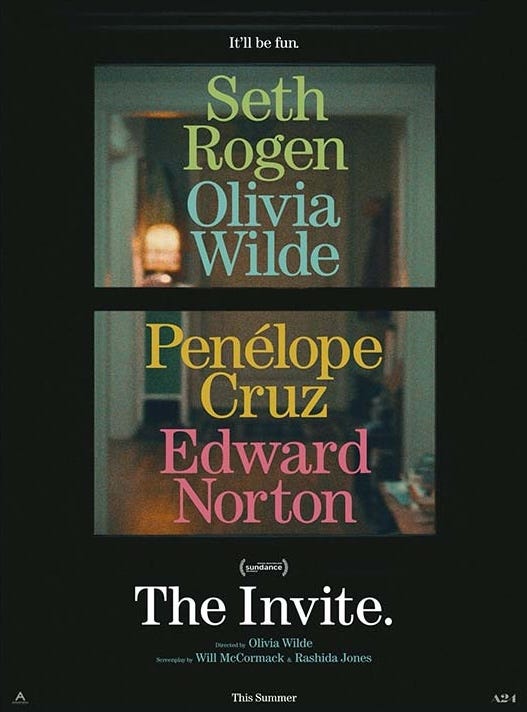
What Is "The Invite" Actually About?
Reviewing the sex comedy that isn't about sex at all.

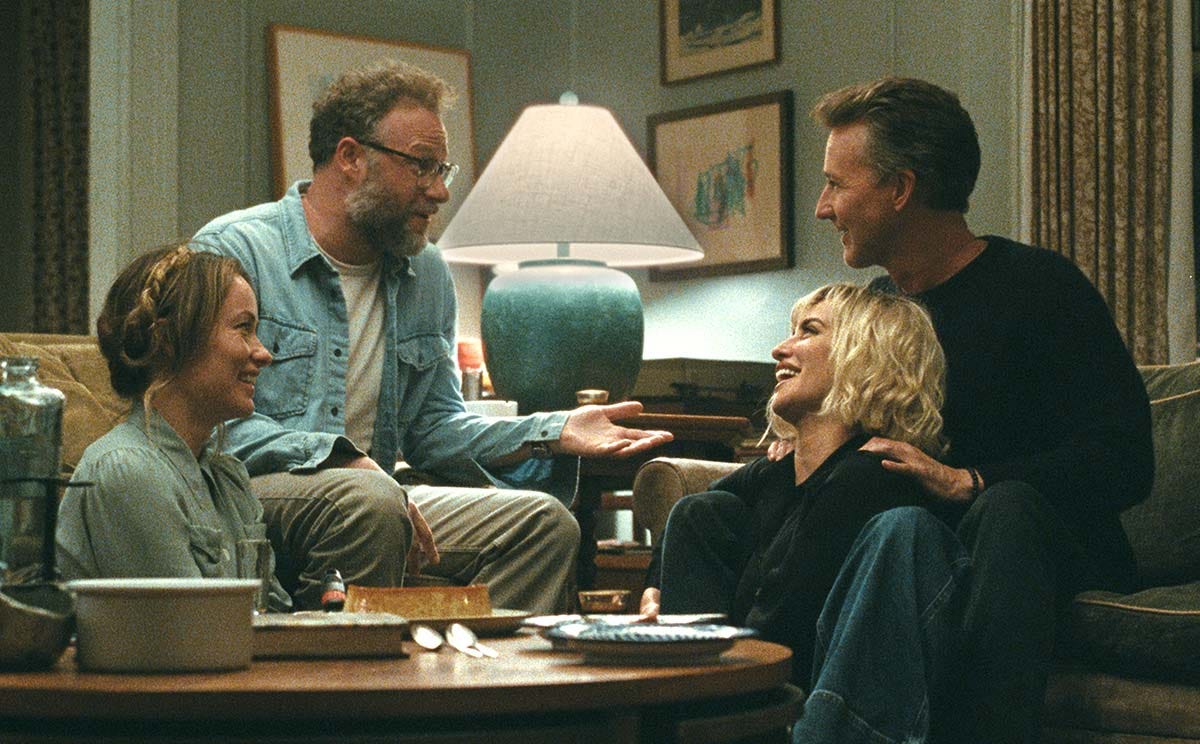
The most recent New York Times article about the film The Invite opens with the statement:
“Art can do things that therapy cannot.”
After 15+ years in various types of therapy, I’m starting to agree.
Especially after watching this movie!
Within seconds of their first on-screen interaction as a couple, it’s obvious that Olivia Wilde and Seth Rogen’s characters are in an agonizing feedback loop of the Gottman Institute’s “four horsemen” of the relationship apocalypse: criticism, contempt, defensiveness, and stonewalling.
Their relationship is dead when the film begins. All hope is lost.
But narratively, the story doesn’t unfold to heal what is already broken. Instead, it gives these suffering people something else: a good look in the mirror.
And that itself, is a gift.
This gift is presented through Edward Norton and Penelope Cruz, their upstairs neighbors who appear to be in the throes of a love affair so powerful it might just rub off and save other people, too.
When you see this film, you’ll be led to believe it’s about polyamory, non-monogamy, or other weird sex stuff that hot, creative people get up to behind closed doors.
It’s not.
I think the movie is actually a roadmap that peels back the curtain on the dissatisfaction of modern relationships.
In The Invite, we don’t see a couple that chose to become deliberate, co-architects of their own lives.
We see two passive victims, weaponizing blame against each other. We see a pair of addicts dedicated to their own narratives of shame and disempowerment.
These people aren’t in love with each other, but they’ve committed themselves to another kind of devotion: misery.
Their situation is a “worst nightmare” for most of us.
Sadly, I can think of countless friends who were exposed to this dynamic, growing up: Parents who were obviously no longer in love, barely tolerating each other’s presence, at each other’s throats, “just staying together for the kids.”
I hadn’t given it much thought before seeing this movie, but I’m so grateful that I wasn’t exposed to this kind of prolonged resentment, as a child.
My unique family unit has plenty of caveats and oddities that wouldn’t make sense to anyone on the outside, but letting things “rot” like that has never been our way. We call each other out, we change, we adapt. We will not be complacent.
But, back to the movie…
In Seth Rogen, we see a “helpless” (emasculated?) man living under the anxious rule of a neurotic, controlling wife (pushed to her own limits by lack of genuinely loving touch, real consideration, and god knows what else).
And if we remove the lens of their dying romantic relationship and look at this more objectively, we can see two people refusing to take ownership over their lives.
And we’ve all been there before, even if it wasn’t about a relationship.
Of course, lack of agency (or choice) is almost always a self-perpetuated illusion.
Even Nelson Mandela, who spent almost 30 years in prison, famously talks about finding agency and personal dignity in the most dire situations. (Far more dire than the “horror” of living with your spouse.)
But the main characters of this film constantly compromise their dignity, in the way they speak to each other, and the way they speak to themselves.
With a few truly tragic exceptions, feeling trapped or “stuck” is usually just a kinky game that we play with ourselves. Denying ourselves the freedom we inherently have from moment to moment becomes the perfect excuse not to grow, not to evolve.
Because that would take a little bit of effort.
That would mean we have to hold ourselves accountable.
And our modern, app-addicted world is full of people who would rather walk way from a relationship altogether, or stay in it passive aggressively just to slowly destroy it with resentment over time, than actually confront themselves.
See: our protagonists!
This film fascinates me because Olivia Wilde and Seth Rogen, as people and celebrities, live very different lives:
Olivia has kids with Jason Sudeikis, a long-time fiancé she never married and had a rather public, ugly falling-out with.
Seth has no children, but he has been with the same woman for more than two decades, and they’ve been married for 15 years.
Neither situation is “correct.”
Each one contains its own trade-offs, unique sufferings and moments of beauty.
One of the most daunting things about relationships is realizing there is no hierarchy that tells us one set of circumstances is objectively better than the other.
The only thing that exists is what we want.
And that notion of choice clearly terrifies the couple in this film. They are so miserable, even as the viewer, we immediately reach for what to blame:
The institution of marriage itself
Pressures of parenthood
Underlying mental health problems
But I’ve noticed the culprit for these deeper feelings of unhappiness and dissatisfaction is almost never something external.
It’s worth mentioning that Esther Perel, a famous psychotherapist, author, sex, and relationship expert served as a consultant on the movie.
(Throw a rock in LA or NYC, and you’ll hit a 30-something who’s read her work.)
On a podcast during the film’s press tour, the cast reflected on the notion of death and rebirth within relationships, which Perel loves to talk about. In the video clip, Edward Norton says we will all have multiple relationships, but some of those can be with the same person.
TLDR: past versions of a relationship that weren’t working must die and be left behind, in order for the possibility of a new one that might work (or turn out to be even better) to be born.
If you want, you can listen to a piece of that interview right here.
When I think about it, this transformation (letting go of a past version of a relationship to clear the way for a new one, with the same person) has occurred in all of my long-term emotional connections: the one I have with each of my parents, my sibling, and with my longest friends.
We fell out of sync and endured stretches of time where we were less close or misunderstood one another, but gradually we evolved, we realized how to move forward with new information about ourselves, and learned how to love each other with even more acceptance.
But this only happened because we had the humility to self-reflect, and… to forgive.
Listen, I understand this is not work that most people do, consciously. A lot of us stay locked in the same friend group, the same work communities, and the same dreams, without actively choosing something deeper.
But no matter the level of introspection I seem to attain, gaining a better understanding myself and my relationships never leads me to an ultimate, final conclusion. It only raises more possibilities, more curiosity, and more questions.
I think The Invite suggests that this is totally okay.
I don’t think this on-screen couple’s collapsing relationship is an alarm bell meant to tell us that romance inevitably dies and twists into resentment and boredom.
That possibility is just the logical future of two people who passively (strong emphasis on this word) drifted through their own marriage and the birth of their child.
They did not talk about things regularly.
They did not nourish their own passions, independently.
They did not creatively design their relationship.
They followed the template of one, and threw their hands up in disbelief and horror when it made them both unhappy.
This is what modern, American culture does to us: it pushes a narrative of individuality and devalues connection. We are a pro-alcohol, pro-money, pro-self culture.
There is no emotional literacy taught in our education system, and we place an enormous emphasis on personal career trajectory, and very little on the benefits of community.
Love is compartmentalized to Disney movies, toxic song lyrics about lust and jealousy, reality TV, and short-form social media content that will convince you in five seconds that you’re dating a narcissist.
Ok, ok, but back to the movie, again…
I can’t help but think the tragedy of these fictional people was preventable:
What would have happened if Olivia Wilde’s character found her own physical practice like dance, breath work or solo-sexual exploration?
What would have happened if Seth Rogen’s character put effort into rediscovering his love for music, or another creative pursuit?
What if they had never moved in together?
What if they hadn’t had a child?
Ask yourself… if your parents hadn’t birthed you or your siblings, do you think they would have stayed together?
It’s an interesting, hypothetical question.
A marriage can be aborted at any time. But children permanently infuse your DNA and finances, and if all goes as planned, they tend to stick around for a long time.
Just saying.
The film’s consultant Esther Perel says that jealousy exists because of a “scarcity model of economics” that teaches us there is a limited supply of love, attraction and energy.
But those resources are not physically tangible, and theoretically, they are infinite.
Even wilder, we can actually expand our own capacity to create even more room for all of those things.
I think most couples frame their relationship around a scarcity mindset, policing each other’s commitments and claiming, “I don’t have energy for you (or this a relationship) because [these goals] are bigger.”
Films like The Invite could give us the confirmation bias that marriage is a recipe for misery and investing in a relationship will lead to the slow death of your real passions.
But it still surprises me that so many of us don’t stop to question this belief system itself.
So many people create (or passively allow) space in their hearts for fear. But could you dare to believe that this space could be filled with anything you want, if you just used your creative imagination?
To me, all this negative talk around relationships in our culture is starting to feel like a sweater that’s three sizes too tight, or a book I’ve read too many times and feel bored with. Boo. Hiss. Yawn. I dare to radically believe in something more extraordinary.
I don’t think The Invite is a movie about “open relationships.” It’s an invitation for us to look at human relationships in a completely new way:
“Relationships are breathing, living organisms that constantly adapt between continuity and change. Stability and novelty. Familiarity and surprise. Security and freedom. All the time.” - Esther Perel
What if we saw every relationship (not just romantic ones) as an ecosystem that’s always changing?
Tell me, what happens to your house plants when you forget to water them?
You don’t stand there telling the plant you just can’t give it what it needs, that it deserves better, that maybe if the right house plant comes along, then finally, you’ll feel motivated to provide more attention and care.
And the plant doesn’t sit there, blaming you. Its leaves simply die, its soil hardens.
Eventually, it takes itself out.
But everything in the biological world around us goes through periods of drought, wetness, death and rebirth.
Find one creature in nature (the hummingbird, the rabbit, the mushroom) and you will see that independence and isolation is not what helps them survive. Only interconnection, in all its messy glory, sustains life.
I don’t think this film is a warning about relationships.
I think it’s a warning about relationships that stretch on and on without any kind of conscious or deliberate renewal.
In my experience, when we stop putting conscious or deliberate renewal into our choices, we start “coasting.”
This is the place where complacency lies, and passion dies.
The film ends with Seth Rogen’s character finally reuniting with his dusty piano, a creative relationship he gave up on many years ago. Olivia Wilde sits silently at his side, listening.
We’re left with a simple image: One person experiencing their own creativity, while another acts as a loving witness.
This is the only shot in the film where these two characters actually seem at peace.
Notice how this moment is not a conversation.
There is no talking.
No resistance.
No demands.
So, maybe art can do things, that therapy cannot.